


We take a systemic approach to content at ércule. One content system includes any variety of subsystems, from product marketing to community engagement to SEO and GEO (sometimes referred to as LLM search).
SEO and GEO have changed a lot this year. I’m reflecting on the seismic shifts and the fundamentals that will probably never change.
TL;DR
- We’ve had to reconsider top-funnel content
- Organic traffic metrics have shifted across the board
- The offsite buyer’s journey keeps growing
- Marketing automation is more friendly than ever
- Writers are putting AI in its proper place
These are the lessons from the past year that will be informing my work next year.
Top-funnel content took a nosedive in 2025
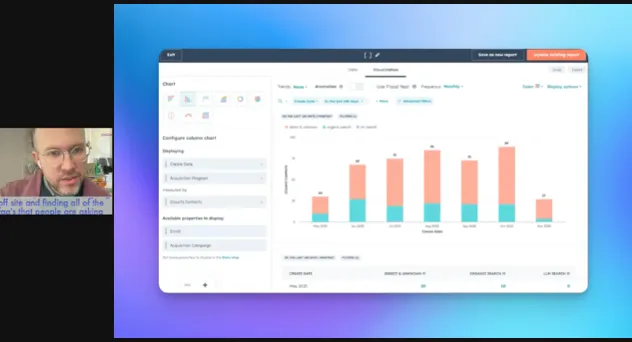
👇 Check out this discouraging traffic report. The kind that you hate to show your boss. Lots of marketers, across industries, wound up showing something like this to their bosses in 2025.

This particular chart is an extreme example because it’s looking specifically at a company’s glossary pages. Top-funnel content performance nosedived in general this year, as AI overviews became more popular. “What is…” pages and glossary pages are providing basic encyclopedia-style knowledge that AI overviews can easily deliver to users. No click-through required.
This shift to LLM search is one of the big stories of 2025.
Does this mean the end of “What is…” pages?
I don’t think so. They still play a role in the information ecosystem and marketing strategy. (LLMs have to get their information from somewhere!) But the ROI for this kind of content has plummeted.

So the investment we put in this content required revision, too. AI-assisted workflows have helped a lot in this regard.
Unbranded traffic is down and LLM traffic is up
As discussed, more people are bringing their questions to ChatGPT and other LLM systems before Google search. Some aren’t even using that Google search bar anymore.
Less search traffic is one consequence, as we discussed. But LLMs are not dissolving inbound clicks entirely. More and more click-through traffic is coming from these LLMs, too.

👆Check out this chart: unbranded clicks (in blue) are trending downward while LLM sessions (in gray) are trending upward.
This is a very simple breakdown. It’s looking at LLM traffic on the whole without differentiating between branded and unbranded LLM traffic. Still, LLM is steadily growing as a traffic source. The difference in overall volume between LLM search and traditional Google search is pretty big but the gap continues to close.
Meanwhile, pipeline volume remains pretty stable
Despite all of this flux, the pipeline data coming from organic search content has been pretty stable. Some of that is from LLMs.
(HubSpot just released a change to be able to track it.)

(The ércule app has some LLM tracking tools, too.)
Here’s an interesting twist to the emerging AI search story: pipeline coming from Google has remained steady even while traffic has trended downward.
This has shed even more light on the actual value of that top-funnel content. If the traffic from “What is…” pages has all but disappeared, and yet conversions remain steady, then we have to wonder: was that intro-level content ever doing much?
The offsite buyer journey is undeniable
The rise of LLM search speaks to a broader trend: more and more of the B2B buyer’s journey is taking place away from your website…
- Community forums like Reddit and StackOverflow
- Crowdsourced info sites like Wikipedia and G2
- AI search tools like GPT, Perplexity, and Gemini
A buyer might start their product research by asking questions of Perplexity, clarify some core concepts with Wikipedia, see what the expert rabble have to say about product options on Reddit, and read user reviews for your company and competitors on G2… all before they decide to check out the pitches on your website.
Marketers are trying to engage with buyers at every step of the journey, which means finding ways to engage with all of these offsite locations. Which brings me to another invigorating change in marketing this year 2025…
We can scale offsite research + engagement now
Buyers are visiting a wider array of sites on their journey and, at first glance, this is a mighty daunting prospect. A complex challenge, if nothing else – one that we’re rising to meet with some complex (but user-friendly) AI tools.
LLM workflows enable us to keep up with these changes and stay active in buyer discussions. For example, this is an automated “FAQ Finder” that I built on a platform called n8n.

I give it a list of topics, then the LLM searches offsite to find all of the FAQs that people are asking. This kind of automated research is great for answering some basic content strategy questions:
- What are customers talking about on various platforms?
- Is our brand mentioned (or participating) in those discussions?
- Does any of our content answer the questions that customers are asking?
- Are ChatGPT or Claude citing our content when those questions are asked?
By answering these questions we get a more detailed view of the problems that our customers prioritize. We also get a glimpse at our brand’s search visibility.
DIY marketing automation is only getting easier
With off-the-shelf products like AirOps, marketers gained the ability to scale their operations this year like never before. But the less expensive, do-it-yourself options are getting more and more accessible.
Let’s zoom in on the research workflow that I mentioned above.

Using a drag-and-drop interface, we’re basically connecting the dots between a bunch of small AI prompts. We chain together all of these little tasks in a linear sequence:
- Read the list of topics I provide, then
- Research each one in Google SERPs, then
- Identify and copy all of the questions you find there, then
- Search these topics on Reddit, then
- Identify and copy all of the questions you find there…
- Etc.
These are pretty simple principles. You can use them to scale nearly every part of your content system. You can even get the workflow to publish content directly in your CMS.
These tools are becoming an important part of the practice. You can run a workflow just like you would run in HubSpot.
Writers are finding real use cases for AI
The AI hype narrative has quieted down this year, at least a little bit. When it comes to writing, anyway. Several years into the AI era, we can all agree that the writing capabilities are… limited. Brilliant (human) writers will never be replaced wholesale by automation tools.
For content teams that are spread thin, or are starting from scratch, we’ve been using LLMs to create some baseline content. We input product and marketing info from a client and the workflows create decent, brand-aligned drafts.
The process is guided by our in-house staff so we’re calling it our “LLM-assisted” content. It’s particularly useful for generating types of content that doesn’t have a huge ROI. Remember how I started this post by talking about the dwindling ROI of top-funnel content? Here’s a fix for it.
Example: a top-funnel post on data mesh
We’re working with a company that is trying to market their product as an alternative to data mesh. Their writing staff is small and we want to use their time for lower-funnel content that has nuance and original research and real point of view.
But top-funnel content is still useful for the overall search visibility strategy. So we’ll create some LLM-assisted material. We could use the workflow to write a “What is…” post about data mesh but Google is already glutted with those pages. So instead we’ll command the workflow to write an introductory piece that has an opinionated thesis – one based on the company’s existing materials.

Five minutes later, the workflow delivers this draft: “Data mesh: what happened?” Not exactly a barnstormer of a title but at least there’s some narrative to it. It’s crowing about the obsolescence of data mesh and wondering how that obsolescence came to be.
Again: it’s not amazing but it's also not bad. A serviceable draft of an intro-level blog post. With a little attention from an in-house editor, it might really pop. Even if they don’t have the time to refine it, the post is a decent foundational layer for the company’s startup blog.
What’s on the horizon for 2026?
As far as I’m concerned, 2026 will be the year of content systems.
Rather than focusing on output, as content marketers have for years, we want our clients to think more about the engine that is generating output.
So we’ll be focused on systemic questions:
- How can we accelerate your velocity?
- How many topics can your team feasibly write about in a quarter?
- How can you free up the people on staff to write the best content possible?
- How can you use that artisanal content to inform AI-assisted content?
- How can you treat your library as a system for educating buyers?
This systemic approach is an unprecedented opportunity for anybody who cares about educating buyers and generating leads with content. Automation tools enable us to learn more about our customers’ problems. These tools can also lead to more joyful and collaborative work across departments.
2025 was a great year for me because I care very deeply about these topics and I love ércule’s clients and I work with brilliant people. That’s not going to change any time soon.