


I work with lots of brilliant marketers and I'm continually amazed by how messy their content strategies end up.
On paper, SEO strategy is simple. In practice, it requires a lot of orchestration of processes, people, and resources. In other words: content systems. Automation tools won't fix your broken content system. Usually they end up amplifying the dysfunctional parts.
In this post we’re getting back to basics. With those fundamentals in place you can lay the groundwork for better automation.
Clear objectives lead to clear system design
What are the outcomes you want? You have to answer that question before you can design an effective content system.
Of course, we're all looking to increase customer pipeline volume but let's not put the cart before the horse. For SEO specifically, your preliminary goals are often search performance goals: better ranking, more clicks, higher click-through rates.
The goals you prioritize will inform the system you design.
Core concepts: content systems for SEO
A content system is a series of repeatable processes that marketers use to plan, create, distribute, and optimize content across all channels. A content system turns your team’s knowledge into structured information that your buyers can use to educate themselves. (Shout out to Lee Densmer for informing my definition.)
The components of a content system for SEO fall into three core groups: people, process, and tools.
People
Your Chief Marketing Officer, content marketing manager, content creators, salespeople, solutions architects, and product engineers... Everyone plays a different role. A smart content system will identify the most impactful roles for everyone involved. It will also set attainable, sustainable expectations for people's contributions.
Processes
We really geek out on the process stuff at ércule. Ideally, every step of every process is routinized so it's as repeatable as the motions of an engine. At the very least, we want templates for processes in all of these categories:
- Planning + strategy
- Production + editorial
- Publication + distribution
- Analytics + maintenance
Every marketing team already has some version of these processes. A content calendar on a whiteboard is proof of planning, production, and editorial systems. Those systems could be refined. In the long-term it will save tons of time.
Tools
This is often the spot where our clients get overwhelmed. If you're worried about getting adequate tools, or blowing out the budget, remember that every tool should be acquired in service of specific processes or tasks. You'll need tools for project management, composition and design, publishing, analytics, reporting, and automation.
A tool, in this context, can be as simple as a shared Google Drive. When it comes to reporting, a simple GA4 account might suffice for new startups. Super-powered Hubspot attribution suites might make sense for more established marketing programs.
When a content system is properly engineered there's a harmony of motion among the people, processes, and tools. The quality of content increases along with the volume. I shed a tear of joy.
Topic selection needs to be focused and disciplined
I always recommend that companies focus on 5-10 core topics at a time.
The goal is to build authority in Google search for every one of those topics. To do so with 20 or 30 subjects at a time isn't practical. Besides, a disciplined topic campaign forces teams to hone their messaging. That’s always a plus.
We use a simple sheet like this to track performance data for those 5-10 core topics:

It's tracking some wide-view metrics for each topic: average rank in Google search, number of keywords that are in play, total clicks, and total impressions.
If your goals are focused on search performance, you can check this little dashboard every few weeks. For startup teams building a program from scratch, these metrics are particularly useful. More established teams might add metrics for LLM visibility and pipeline conversion.
Channel-specific research for SEO
If we’re going to reach the right buyers and win their trust, we have to go where they’re hanging out and join the discussions they’re having. Each channel has its own conceits and metrics.
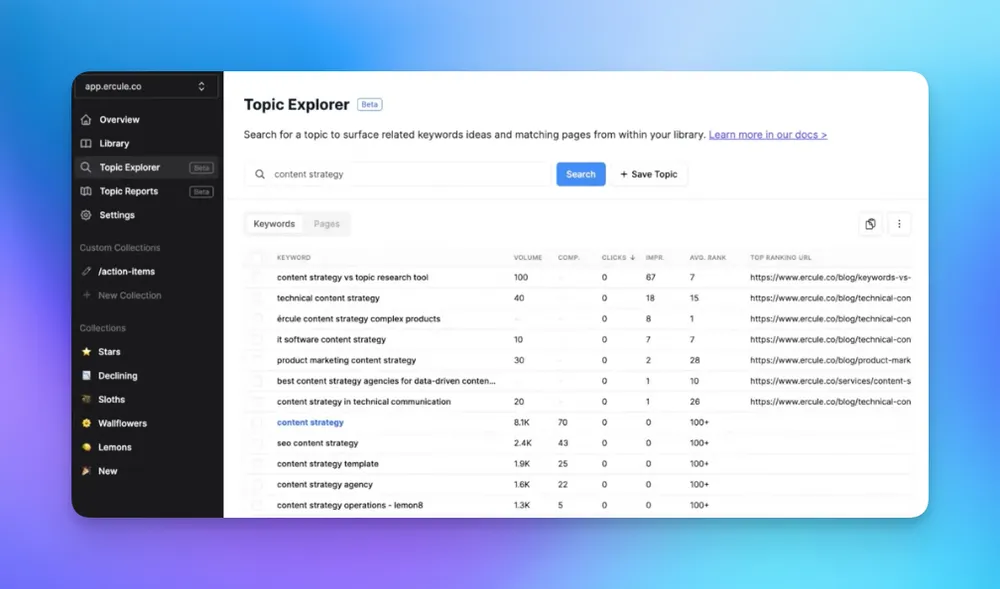
SEO is the most basic example of this. I use the ércule app for keyword research. It allows me to quickly search keyword data for any topic that my clients might be considering. (It will also track performance for chosen keywords later in the process.)

In the example above, I searched for the phrase "content strategy." The right-most column shows the URLs from my website that are ranking for any related keywords.
There are plenty of tools on the market that help with this kind of competitive research. Ahrefs, Profound, and Scrunch are all excellent but not every marketer needs the bells and whistles provided by pricey tools.
Community-specific research
Keyword research is useful for SEO campaigns but the buyer's journey is now more multi-faceted than ever. A robust content system can account for this fact.
Your buyers are probably consulting Reddit, for example. In order to meet your audience there you have to be up on the discussions they’re having. We use a modest LLM workflow to conduct that research.

It identifies questions that people are asking across a variety of channels and consolidates those questions in a single spreadsheet.
Channel-specific data like this enables us to be more useful to buyers on those channels. It also, in aggregate, provides a more nuanced view of their problems.
The answers we compose for a channel like Reddit or LinkedIn can be adapted for other channels too. This multi-channel approach naturally extends into optimizing for AI search and LLMs, where content freshness and authenticity matter even more.
SEO is a great place to start refining your content system
The fundamentals of SEO have had time to solidify. If you invest today in a more robust content system for SEO you don't have to worry about radically overhauling it next year.
Of course, SEO is only one part of a content system. SEO alone won't build up your customer pipeline. In that sense it's a great starting point: standardized, reliable, effective. The lessons you learn while engineering SEO will save you time when you engineer the other parts of the system: product marketing, social, events, documentation libraries, AI search, all of it.