


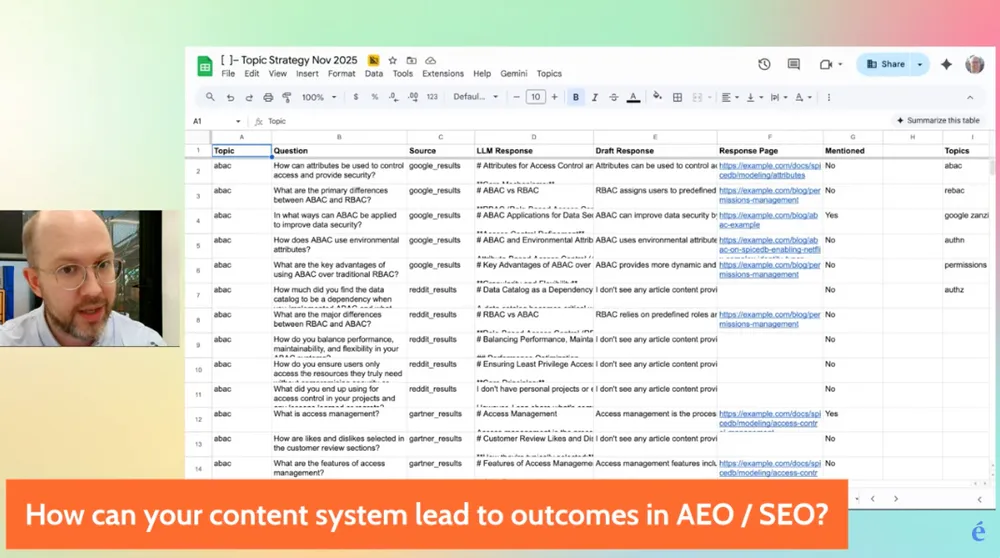
Buyers aren't just using Google anymore. They're asking ChatGPT, Claude, Perplexity, and other AI tools for recommendations, explanations, and solutions.
If your content isn’t optimized for LLMs, you’re missing out on those conversations. The traffic is modest but growing and seems to convert well.
While this young channel is still very much in flux, marketers already have a model for it: SEO. A strong SEO program translates pretty directly to AI search.
AI search is more dynamic and less predictable than SEO
People engage with the Google search bar in a straightforward way: type your question then click on a page to see if it contains the info you seek. AI search is more dynamic and less predictable – often less clickable. Getting seen in AI search is a matter of being cited, referenced, and synthesized by large language models (LLMs) in their generated responses.
For SEO, you optimize for keyword rankings, click-through rates, and page authority. For AI search, you optimize for citation. Both channels require fresh, authentic, well structured content. In order to best your competitors in either channel you’ll need to build credibility and authority through your content.
As with SEO, I recommend that marketers focus on winning 5-10 core topics at a time in AI search. Ideally, these are topics that people are already bringing to search tools like ChatGPT and Gemini.
Tracking visibility in AI search and LLMs
At ércule, we've built tools to track LLM visibility alongside traditional SEO metrics. Here's what that looks like in our app:

The above screenshot shows inbound traffic from LLM search queries. You can click on “All traffic” and “Organic traffic” to chart those metrics in the same view.
I recommend that teams focus on production and performance for no more than 5-10 topics at time across all channels. This focused, disciplined approach is just as important for AI search as it is for traditional search.
Content freshness and authenticity
LLM search tools care deeply about content freshness and authenticity. ChatGPT prioritzes fresh content in its citations. Original insights and genuine expertise stand out.
This is where multi-channel research pays dividends. Any FAQ content that you’ve created to answer questions on platforms like Reddit can be added to your website content. Supplemental content like this, based on real questions from real people, helps to build visibility in AI search. It demonstrates an authentic understanding of your audience's problems and, ideally, it’s written in the kind of clear, conversational language that LLMs recognize.
The future of content is systematic
Even as Google's algorithm has changed hundreds of times, the fundamentals of SEO have remained relatively constant over the past thirty years. SEO “hacks” have come and gone. Useful content, written in an accessible way, and optimized for visibility: this has been a failsafe strategy all the way through.
I think the same will prove true for AI search. The tactics we rely on today for AI search might not be reliable in 18 months but the fundamentals of utility, accessibility, and freshness won’t change much. That's exactly why you need a systematic approach now. With the fundamentals in place you’ll be better equipped to adapt as the channel evolves.